To calculate the flow rate for a trapezoidal channel, first, identify the bottom width, side slope, and flow depth of the channel. The cross-sectional area (A) corresponding to the depth of flow (y), channel bottom width (B), and side slope (θ) is determined by:
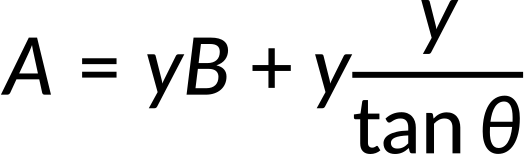
Next, calculate the wetted perimeter, which includes the bottom width and the sloped side lengths in contact with the water. Using the values of the cross-sectional area and the wetted perimeter, determine the hydraulic radius by dividing the area by the perimeter. Select an appropriate Manning’s roughness coefficient based on the surface material of the channel. Apply Manning’s equation by substituting the hydraulic radius, channel slope, and roughness coefficient to find the flow velocity. Finally, calculate the flow rate by multiplying the flow velocity with the cross-sectional area. Always use consistent units throughout the process.
Consider a trapezoidal channel where water flows steadily at a certain depth, with a specified bottom width and side slopes angled to form the channel's cross-section.
The channel bottom has a specified slope, which directly affects the flow velocity.
Using these parameters, the goal is to calculate the flow rate for this channel configuration.
The calculation begins by determining the cross-sectional area, combining contributions from the bottom width and the sloped side sections.
Next, the wetted perimeter, consisting of both the bottom and side surfaces in contact with water, is calculated.
Using these values, the hydraulic radius is obtained by dividing the cross-sectional area by the wetted perimeter.
The Manning resistance coefficient, n, is selected for finished concrete lining to account for surface roughness.
The hydraulic radius, together with the channel slope and other parameters, is substituted into Manning's equation.
After the calculations, the flow rate is determined, representing the volume of water passing through the channel per unit of time.

 繁體中文
繁體中文


