Exponents provide a compact and efficient way of representing repeated multiplication. These tools are fundamental to algebra and broader areas of mathematics, including scientific computation, scaling laws, and dimensional analysis.
Exponent Rules and Properties
Exponential notation expresses the repeated multiplication of a number by itself. For any nonzero real number a and integer n, an represent a multiplied by itself n times. Key properties include:
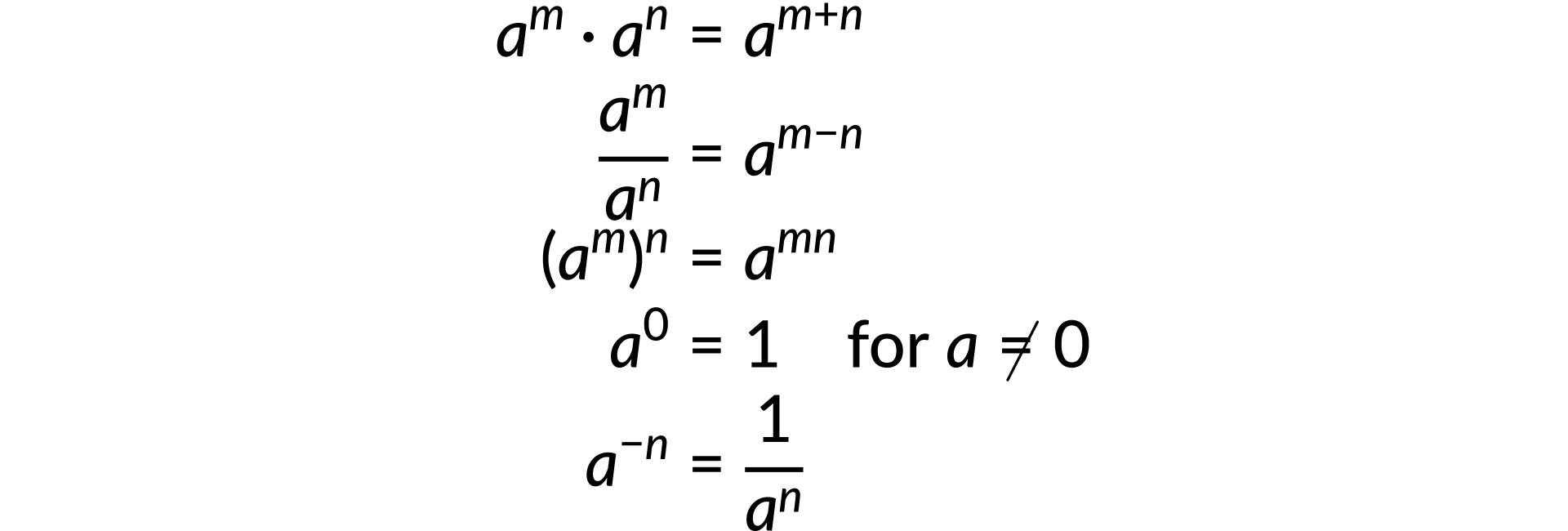
These properties allow for the simplification and manipulation of exponential expressions in both symbolic and numerical contexts.
Scientific Notation
Scientific notation expresses numbers as a ✕ 10n, where 1 ≤ a<10 and n is an integer. It simplifies operations on extremely large or small quantities, which is common in scientific contexts. For example, 4.6 ✕ 10-4 denotes a small number, while 6.97 ✕ 109 represents a large one.
Calculations involving scientific notation use the same exponent rules, allowing multiplication and division to be performed efficiently by operating on the coefficients and adjusting the powers of ten accordingly. This makes scientific notation a powerful tool for maintaining precision and readability in quantitative work.
A cube with 1-meter sides has a volume of 1 cubic meter—or, one to the third power.
Scaling up the edge to 2 meters increases the volume to 8 cubic meters.
The number being multiplied is the base, and the exponent shows how many times it’s multiplied by itself.
Stacking two identical 2-meter cubes doubles the volume. The total volume equals the volume of the original cube—2 times 2 times 2 cubic meters—multiplied by two for the second cube, or two to the third times two to the first.
When multiplying powers with the same base, the exponents are added. This gives two to the fourth, resulting in 16 cubic meters.
When a cube is divided evenly along one dimension, the volume is halved. The new volume equals the volume of the original cube divided by two—that is, two to the third power divided by two to the first.
When dividing powers with the same base, the exponents are subtracted. This results in two to the second, or four cubic meters.
These follow exponent rules: when multiplying, add exponents; when dividing, subtract them.
Exponents with powers of ten are used in scientific notation to express values like Earth’s diameter or red blood cell size.

 繁體中文
繁體中文


