In systems where values diminish by a constant proportion at each stage, the resulting sequence follows a geometric structure. Each new value in the sequence is obtained by applying a fixed multiplier to the preceding term. This regular, proportional decline type is often used to represent processes involving gradual loss, such as energy dissipation or reduction in amplitude over time.
When analyzing the total effect of such a process across unlimited iterations, the series of values is referred to as an infinite geometric series. Suppose the magnitude of the common multiplier—known as the common ratio—is less than one. In that case, the values in the sequence continue to decrease, and their accumulated total approaches a definite number. This condition ensures convergence rather than unbounded growth or fluctuation.
The formula to determine the total sum of an infinite geometric series is:
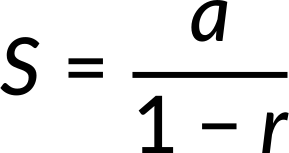
where S represents the sum of the series, a is the initial value, and r is the common ratio. This mathematical expression allows for efficient calculation of long-term outcomes in processes that exhibit exponential decrease. Applications span a variety of fields, including physics, economics, and engineering, where such decay models are essential for accurate prediction and analysis.
Consider a ball being dropped from a certain height onto a hard surface. After each bounce, it rebounds to a fixed fraction of the height it reached in the previous bounce.
The rebound heights follow a geometric pattern, with each new height being a consistent fraction of the one before.
The fixed value used for multiplication is called the common ratio.
The first term represents the initial rebound height, and each subsequent height is calculated by multiplying the previous term by the common ratio.
This process models exponential decay, as the ball loses energy with each bounce.
Subsequently, the total cumulative distance covered after several bounces is calculated by doubling each rebound height to account for both the ascent and descent, except for the initial drop.
Once each term of the sequence is doubled, partial sums—defined as the sum of a fixed number of terms—can be used to calculate the ball’s total cumulative distance covered at any point.
To find the nth partial sum, write the sum and multiply it by the ratio, shifting all terms forward. Subtracting cancels the middle terms, leaving only the first and last.
Factoring and dividing yield the nth partial sum, showing how geometric sequences work in real situations.

 繁體中文
繁體中文


