In coordinate geometry, determining the central point between two locations is common. This central point, or midpoint, lies exactly halfway along the line segment connecting two points in a two-dimensional space. It has applications in mathematics, physics, engineering, and various planning disciplines.
Given two points labeled as A (x1, y1) and B (x2, y2) on a coordinate plane, a straight line segment can be plotted between them. The midpoint, labeled point M, divides this segment into two equal parts. By definition, the horizontal distance from point A to M is equal to the distance from M to point B, as is the vertical distance.
To find the coordinates of point M, the midpoint formula is used:
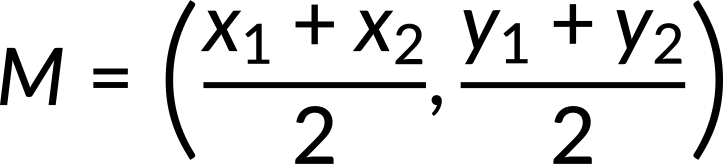
This formula calculates the midpoint by averaging the x-values and y-values of the two endpoints, respectively. The result is a new coordinate point representing the exact center of the segment between A and B.
The midpoint formula is fundamental in problems involving symmetry, geometric constructions, and optimization. Whether the task involves balancing spatial resources, designing efficient layouts, or analyzing geometrical relationships, the midpoint provides a precise and reliable solution for locating a central position in a two-dimensional context.
Two telecom towers—essential for transmitting cellular signals—are situated in different locations. A new signal booster—used to improve signal strength—needs to be placed centrally between them.
To determine this optimal location, the midpoint formula is used to find the halfway point between their positions.
The towers' positions are labeled as point A and point B, representing their locations on a coordinate plane.
A straight line segment connects these two points, and the midpoint of this segment is labeled as point M.
Since point M is positioned halfway along the segment, the horizontal distance from point A to M equals the distance from M to point B.
Solving for the x-coordinate of the midpoint M gives the average of the horizontal values of points A and B.
The vertical coordinate of M is found in a similar way, by averaging the vertical values of both points.
This method defines the midpoint formula as the average of the x- and y-coordinates of points A and B.
On a regional map, this midpoint lies directly between the two locations, ensuring balanced and efficient signal coverage for both.

 繁體中文
繁體中文


