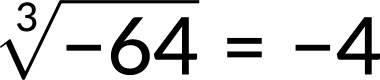
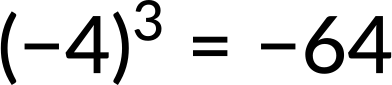
Roots, often written as radicals, identify the quantity that must be raised to a specific exponent to produce a given value. A radical expression consists of two main components: the radicand, which is the value placed inside the root symbol, and the index, which indicates the degree of the root being taken. The notation n√a indicates the principal nth root of a. If n equals 2, the operation is the square root, while n = 3 defines the cube root. When n is even, a negative radicand does not yield a real result; with odd indices, negative radicands generate negative outputs. For example, ∛(-64) = -64, since (-4)3 = -64.
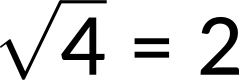
Certain roots can be simplified directly, as in √4 = 2. Radical expressions follow key relationships:
These properties allow the removal of perfect powers from under the radical sign. For instance, √32 simplifies by factoring as √(16 x 2) = 4√2. This process, known as extracting perfect roots, is fundamental for presenting radical terms in reduced form or for further algebraic operations.
Radicals represent root operations; the number inside the root is the radicand, and the small number on the root is the index, not equal to 1 or 0.
If no index is shown, it is considered 2 and called the square root. An index of 3 is the cube root. Higher indices are the fourth root, fifth root, and so on.
Radical inverts the whole number index in the exponent; raising it back to that index gives the radicand.
In the real number system, negative radicands with odd indices yield negative results, but with even indices, they have no solution, since no real number squared equals a negative.
Consider a square floor with side length a and an area of 32 square meters. Then a is the square root of 32, which simplifies to 4 times root-2 meters, linking dimension to radicals.
Radicals follow clear rules: the root of the product of two numbers equals the product of their roots; the root of a fraction equals the root of the numerator over the root of the denominator.
A radicand raised to a power can be written as the radical raised to the same power. These rules help simplify radicals efficiently.

 繁體中文
繁體中文


