A differential equation is a mathematical expression that establishes a relationship between a function and its derivatives. These equations are fundamental in modeling dynamic systems across various fields of science and engineering. The order of a differential equation is defined by the highest order derivative present in the equation. A first-order differential equation includes only the first derivative, while a second-order differential equation includes up to the second derivative of the unknown function.
Second-Order Differential Equations in Physical Systems
A classic example of a second-order differential equation arises from modeling the motion of a spring–mass system. In this idealized system, a mass is attached to a spring that obeys Hooke’s Law and is free from any damping or external forces. When the mass is displaced from its equilibrium position, the spring exerts a restoring force that is linearly proportional to the displacement and acts in the opposite direction. Mathematically, this restoring force is given by

where k is the spring constant and x is the displacement from equilibrium.
According to Newton’s second law, the net force acting on an object is equal to the product of its mass and acceleration. Substituting the spring force into Newton’s law yields

When acceleration is expressed as the second derivative of displacement with respect to time.
Rearranging terms leads to the standard form of the second-order linear differential equation:
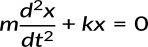
This equation describes simple harmonic motion and serves as a foundational model in the study of mechanical vibrations and oscillatory systems.
A differential equation is an equation that contains an unknown function and one or more of its derivatives. The order of a differential equation is given by the highest order derivative present in the equation.
When the equation involves only the first derivative, it is called first order. If it involves the second derivative, it is called second order, and so on.
For example, a spring-mass system can be modeled as a simple harmonic oscillator, which equates the net force on the mass and the restoring force in the spring, described by Hooke’s law for linear springs.
The spring force acts in the direction opposite to the displacement and is proportional to how far the mass moves from its equilibrium position.
Newton’s second law links the net force on the mass to its acceleration. Combining these two relationships gives an equation in which mass times acceleration equals a negative constant times displacement.
By rewriting acceleration as the second derivative of displacement over time, a second-order differential equation is obtained.
This second derivative links the motion of the system to a differential equation.

 繁體中文
繁體中文