In calculus, the Product Rule provides a method for differentiating expressions that are the product of two functions. It states that the derivative of the product of two differentiable functions equals the first function times the rate of change of the second, plus the second function times the rate of change of the first.
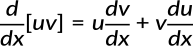
This rule ensures that the rate of change of the product accounts for the simultaneous variation of both functions.
A compelling way to understand the Product Rule is through a geometric analogy involving a rectangle whose width and height change over time. Let the width and height represent two functions of time, making the area their product. When both dimensions vary, the change in area over a small time interval can be visualized as consisting of three components: a strip along the width, a strip along the height, and a small square at the corner.
The strip along the width represents the change due to increasing width while holding height constant. The strip along the height captures the change due to increasing height while holding the width constant. The small square at the corner, representing the combined increase in both dimensions, becomes negligible as the time interval becomes very small.
Dividing the total change in area by the time interval and letting that interval approach zero, the corner term becomes infinitesimally small and vanishes. What remains are the two linear contributions from the changing width and height.

This visual model reinforces the necessity of including both partial changes to capture the full dynamic behavior of the product of two changing quantities.
The Product Rule differentiates functions formed by the product of two functions.
It says the derivative of two functions u and v is the sum of u times the derivative of v and v times the derivative of u.
To understand why, imagine resizing a rectangular window on a screen. Its area equals width times height.
As both width and height change over time, the total area also changes. This change can be visualized by new pixel blocks being added along the edges and at the corner.
The total area expression has three parts: one from the width, one from the height, and one from the corner. To find the rate of change, the total area change is divided by the time interval.
Taking the limit as the time interval approaches zero, the first part becomes height times the rate of change of width. The second becomes width times the rate of change of height.
The corner part shows the product of the tiny change in width and the tiny change in height. As the limit approaches zero, the corner part, which depends on time, vanishes.
The result matches the product rule, showing each function times the derivative of the other.

 繁體中文
繁體中文