In calculus, higher-order derivatives extend the idea of differentiation beyond the first derivative to capture successive rates of change. These derivatives provide detailed information about the behavior of functions and have important applications in both mathematics and physics. To illustrate these concepts, consider the example function
begin{equation*}
f(x) = x^3 - x
end{equation*}
which serves as a useful case study for exploring higher derivatives.
The first derivative represents the slope of the original function. The second derivative then describes how this slope is changing.
begin{equation*}
f'(x) =3 x^2 - 1
end{equation*}
begin{equation*}
f''(x)=6x
end{equation*}
For the example given, the second derivative turns out to be a linear function, indicating a steady rate of change in slope. Differentiating once more gives a constant third derivative, and the fourth derivative becomes zero. This sequence highlights how a function's behavior can be fully characterized through its successive derivatives. Graphically, the second derivative reveals the concavity of the original function—whether the graph curves upwards or downwards. For the given example, the second derivative is positive where the graph is concave up and negative where it is concave down. A constant third derivative implies the concavity changes at a uniform rate.
In physical contexts, higher derivatives describe familiar quantities. The first derivative of a position function represents velocity, the second represents acceleration, and the third, known as jerk, describes the rate of change of acceleration. These derivatives help analyze motion in systems where smooth transitions are essential, such as vehicle dynamics or robotics.
Higher derivatives can be extended indefinitely. The nth derivative provides increasingly refined information about a function’s behavior. In later applications, such as Taylor series, these derivatives become essential for approximating complex functions and modeling physical systems.
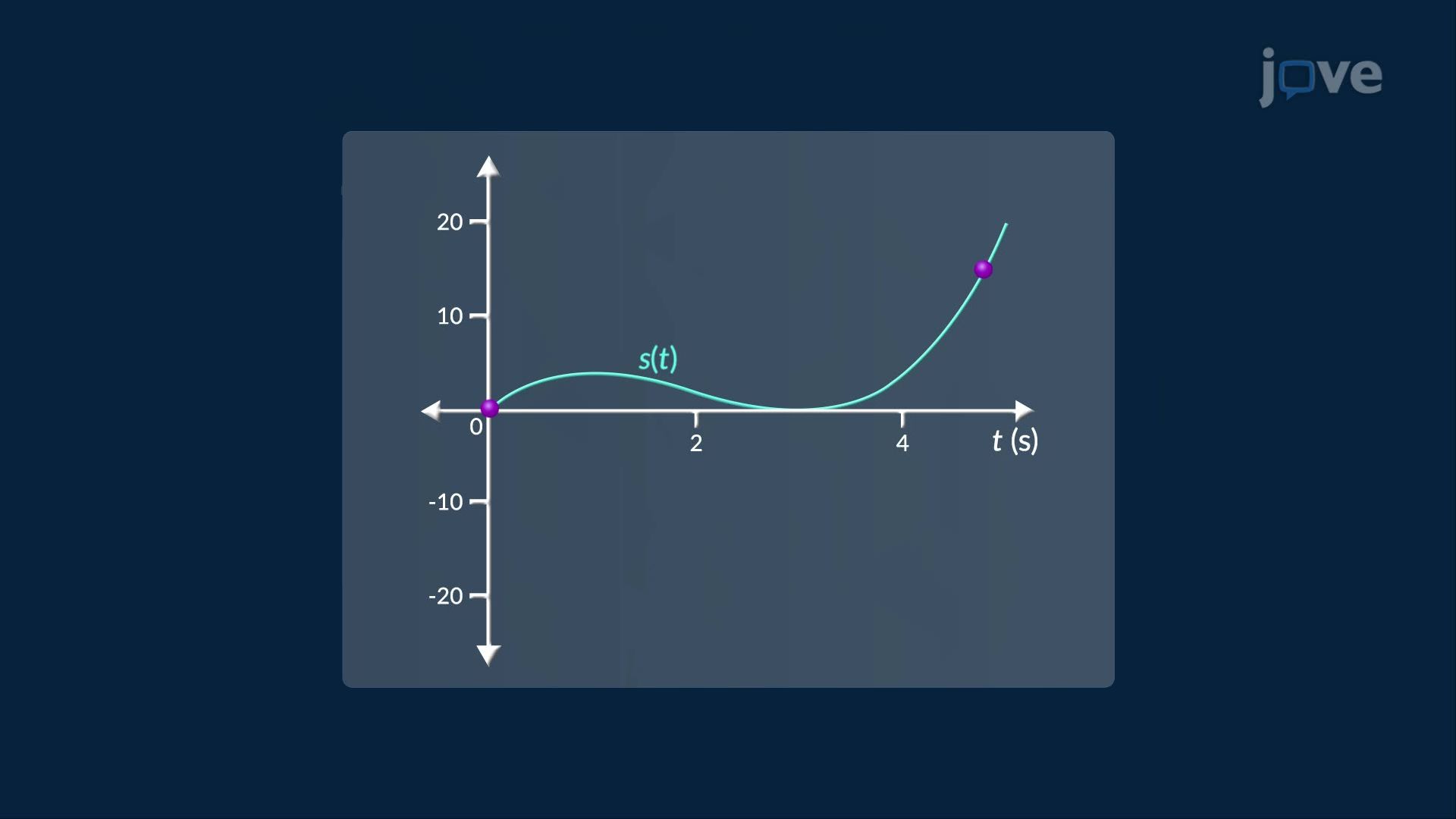
A motorbike starts from rest and moves in a straight line. Its position changes over time, described by a position function.
As the position changes with time, the slope of the plot gives velocity—the rate of change in position, which is the first derivative of position. This value is what one sees on the speedometer.
When velocity changes with time, either by speeding up or slowing down, this change is called acceleration—the second derivative of the position. A linear increase in velocity gives positive acceleration, and a decrease gives negative acceleration.
Acceleration can also vary. A quick twist of the throttle or sudden braking abruptly changes it. This rate of change of acceleration is called jerk —the third derivative of the position. Jerk describes how gradual or abrupt the acceleration changes.
These derivatives form a hierarchy: position gives location, velocity is the rate of position change, acceleration is the rate of velocity change, and jerk is the rate of acceleration change. In everyday life, motion is primarily described by velocity and acceleration.
But when highly precise cruise control is needed, higher-order derivatives like jerk are also considered.

 繁體中文
繁體中文