Integration by parts is a fundamental technique in calculus for evaluating integrals involving the product of two functions. It is particularly useful when direct integration is not feasible. The method is based on the product rule for differentiation, which states that the derivative of a product equals the derivative of the first function times the second, plus the first function times the derivative of the second. By integrating this identity and rearranging terms, the integration by parts formula is derived.
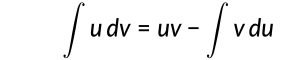
The technique works best when one function simplifies through differentiation, while the other can be directly integrated. The function chosen for differentiation is denoted as u, and the one selected for integration as dv. The resulting formula allows the original integral to be rewritten in terms of simpler components, facilitating its evaluation. The integration by parts formula is given by:
An illustrative application of integration by parts arises in the analysis of alternating current (AC) circuits. In such systems, the current may be represented as a product of time-dependent functions, such as a linearly increasing amplitude modulating a sinusoidal waveform. To determine the voltage across a capacitor, it is necessary to integrate this product over time. By appropriately choosing one component of the current function for differentiation and the other for integration, the integration by parts method facilitates the computation.
This technique not only aids in solving integrals encountered in calculus but also extends to engineering contexts, where it supports the analysis of complex signals and dynamic systems. Integration by parts remains a vital tool in translating physical relationships into mathematical expressions that can be evaluated systematically.
Integration by parts is a method for evaluating integrals involving the product of two terms, a function and a differential.
The formula is derived by applying the product rule of differentiation to the product of two functions.
Integrate both sides with respect to x. By substituting standard notations for differentials and rearranging terms, the integration by parts formula is obtained.
For instance, when integrating x multiplied by a cosine function, the integrand is split into two components. Typically, the function that simplifies upon differentiation is chosen as u, and the other as dv.
The function u is differentiated, and dv is integrated. These are then substituted into the integration by parts formula to get the final result.
This method plays a role in many analyses. For instance, consider an AC circuit where the current is a product of two functions.
To calculate the voltage across the capacitor, the current must be integrated. By selecting one function to differentiate and the other to integrate, the integration by parts method can be used to evaluate the result efficiently.

 繁體中文
繁體中文