In calculus, the concept of antiderivatives serves as the reverse operation of differentiation, akin to retracing the steps of a dynamic process to determine its initial state.
An antiderivative of a function f(x) is another function F(x) such that its derivative yields the original function:

Since differentiation eliminates constant terms, an antiderivative is not unique; instead, it includes an arbitrary constant C, leading to the general form:

This constant accounts for unknown initial conditions when reconstructing a function.
The power rule simplifies the process of finding antiderivatives for polynomial functions. Given a function:


These formulas enable systematic reconstruction of original functions from their derivatives, mirroring how an object's position can be inferred from its velocity over time.
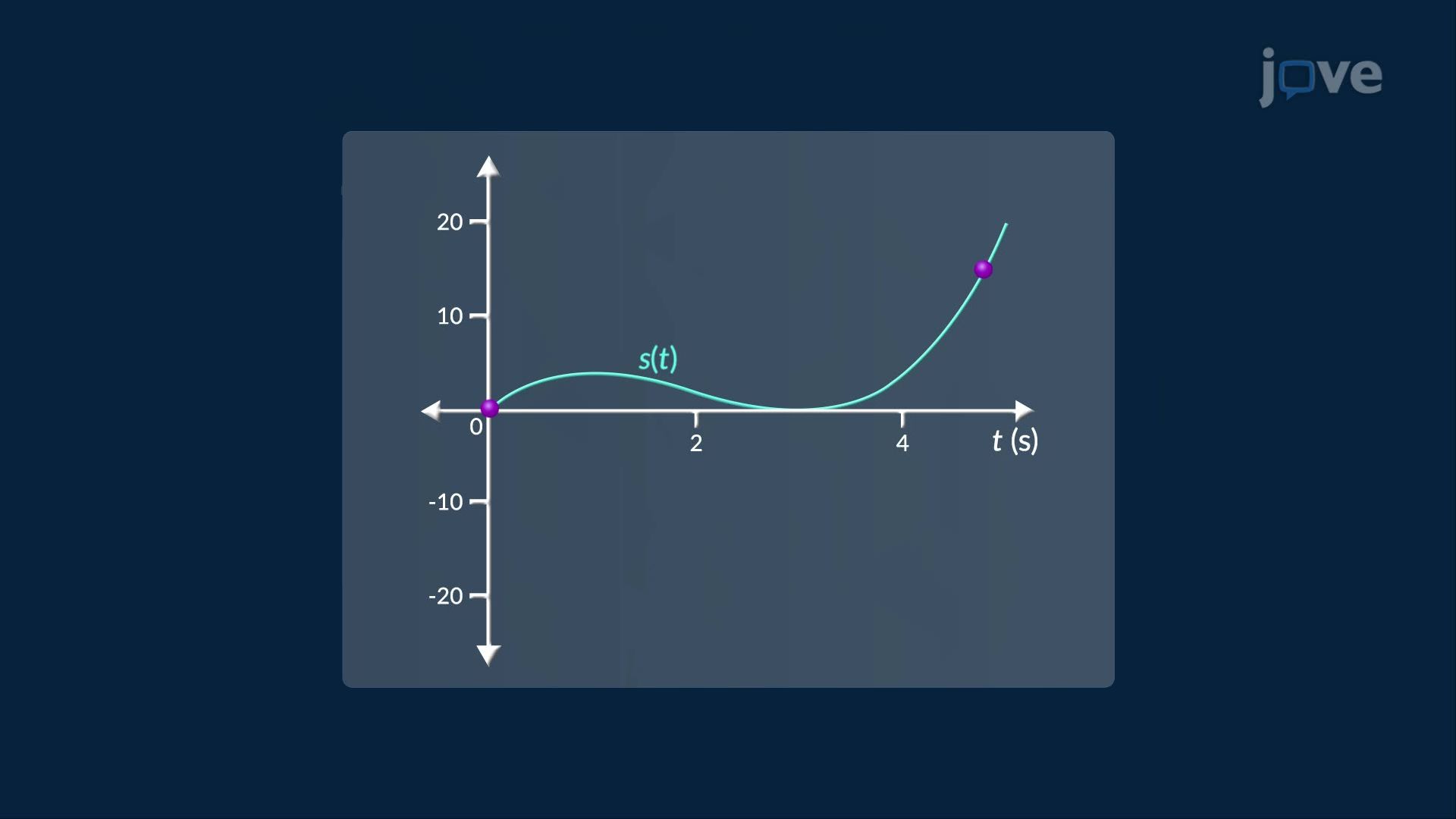
When a ball moves along a curved path, its velocity is expressed as the derivative of its position function. This derivative represents the instantaneous rate of change of position with respect to time.
If the velocity function is known and the position function is required, the operation must be reversed. This reversal is achieved through the antiderivative.
An antiderivative of a function is a new function whose derivative reproduces the original function.
Antiderivatives are not unique. For example, the derivative of x squared is two x, and the derivatives of x squared plus five, x squared minus five, and x squared minus seven are also two x. These expressions differ only by a constant term.
Because the derivative of any constant is zero, constant information is lost under differentiation. To represent all possible functions that share the same derivative, the general antiderivative is written as a particular antiderivative plus an arbitrary constant C.
This constant, known as the constant of integration, shows an entire class of functions that differ only by a constant shift. By applying the same concept, the position function for the ball can be found.

 繁體中文
繁體中文