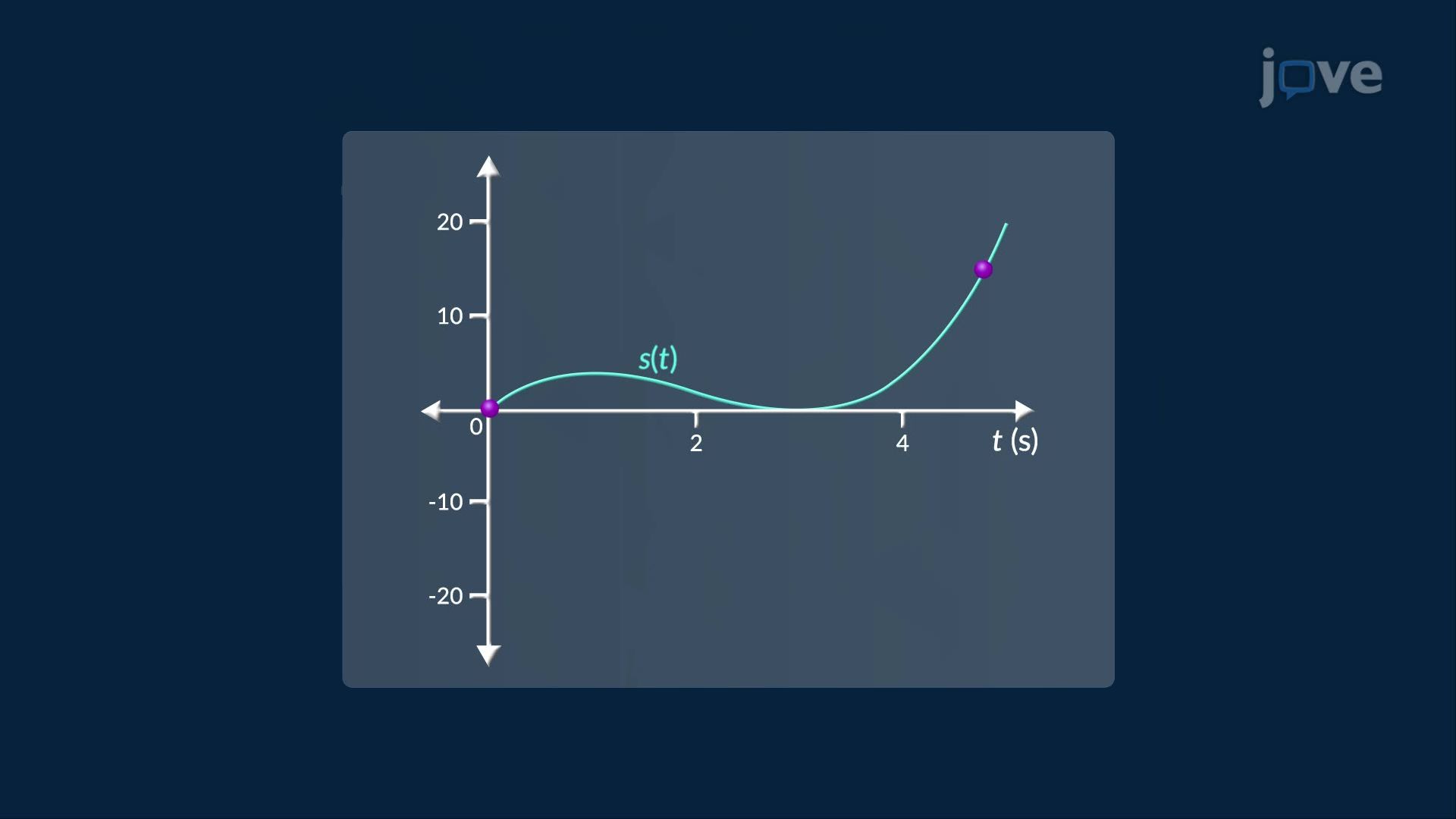
The concept of an antiderivative is fundamental in calculus, describing how a function's values accumulate over time. This process is closely related to physical motion, such as the movement of a rolling ball. As the ball progresses, its position changes in response to variations in velocity, just as an antiderivative graph reflects the cumulative effect of the original function's values.
Graphing an antiderivative requires interpreting how a function's values influence the shape of its accumulating curve. The antiderivative increases when the original function is positive, representing a growing accumulation. Conversely, when the function is negative, the antiderivative decreases, indicating a reduction in accumulated values. Points, where the function equals zero, correspond to local extrema in the antiderivative, where its slope momentarily flattens, forming peaks or valleys.
The steepness of an antiderivative graph depends on the magnitude of the original function. Larger positive values lead to steeper upward slopes, while larger negative values create steeper downward slopes. When the function approaches zero, the antiderivative's slope diminishes, producing more gradual transitions. A constant function results in a straight-line antiderivative with a uniform slope, while functions that change gradually generate smooth, flowing curves.
Even without an explicit equation, the general shape of an antiderivative can be inferred by analyzing the trends of the original function. Observing where the function increases or decreases and how sharply it changes allows for a reasonable approximation of the antiderivative's behavior. This behavior highlights the fundamental relationship between differentiation and integration, reinforcing that integration represents the accumulation of infinitesimal changes over time.
A car moves on a highway with changing velocity. This change is described by a velocity function and a position function. Differentiating the position function gives velocity, which is the slope of the position graph. The antiderivative of velocity gives position. Using ideas from the first and second derivatives, the velocity graph shows how the position antiderivative rises, falls, and bends.
From time zero to t1, velocity—or the slope—is positive and increasing, meaning the position graph is increasing and concave up.
In the next interval, velocity is constant and positive. The position graph has a steady, positive slope forming a straight line.
Next, velocity is positive but decreasing. The slope decreases, so the position graph is increasing and concave down.
When velocity approaches zero, the slope becomes zero, and the position remains nearly constant.
Next, velocity is negative and decreasing over the following interval, resulting in a position graph that is decreasing and concave down.
In the final interval, velocity is negative but increases toward zero. The position graph is decreasing, concave up, and approaching a constant.

 繁體中文
繁體中文