A derivative describes how one quantity changes with respect to another, such as how velocity changes over time. The reverse process, which recovers a quantity from its rate of change, is known as integration. In physics, integration is fundamental because it links related physical quantities, allowing acceleration, velocity, and displacement to be understood as connected aspects of motion.
Consider a car traveling at a steady speed of 20 meters per second when an obstacle appears 800 meters ahead. To stop before reaching the obstacle, the car slows down with a constant acceleration. Acceleration indicates how the car’s velocity changes over time. By applying integration to this constant acceleration, the velocity of the car can be described as a function of time. This description includes a constant that reflects the fact that the car already has a nonzero speed at the moment braking begins, which corresponds to its initial velocity.
Velocity describes how position changes with time. Applying the same reasoning again allows the car’s displacement to be described over the braking interval. This step also involves a constant, which represents the initial position of the car. If the position is defined as zero at the instant braking starts, this constant vanishes.
The car comes to rest when its velocity reaches zero. This condition determines how long the braking process lasts. That stopping time can then be used to evaluate how far the car travels while slowing down. By requiring this distance to be exactly 800 meters, the magnitude of the required acceleration can be determined.
This example demonstrates how integration provides a clear conceptual link between acceleration, velocity, and displacement, showing how changes in motion accumulate over time to produce observable outcomes.
A derivative describes how a quantity changes with respect to its input variable. An antiderivative reverses this, recovering the original function from its rate of change.
This reverse process is called integration. It helps find velocity from acceleration and displacement from velocity.
Imagine a car moving steadily at 20 meters per second, and an obstacle appears 800 meters ahead of it.
To stop before reaching the obstacle, assume the car slows down with a constant acceleration a. Integrating this acceleration gives the velocity as a function of time.
The integration constant is found to be equal to the initial velocity.
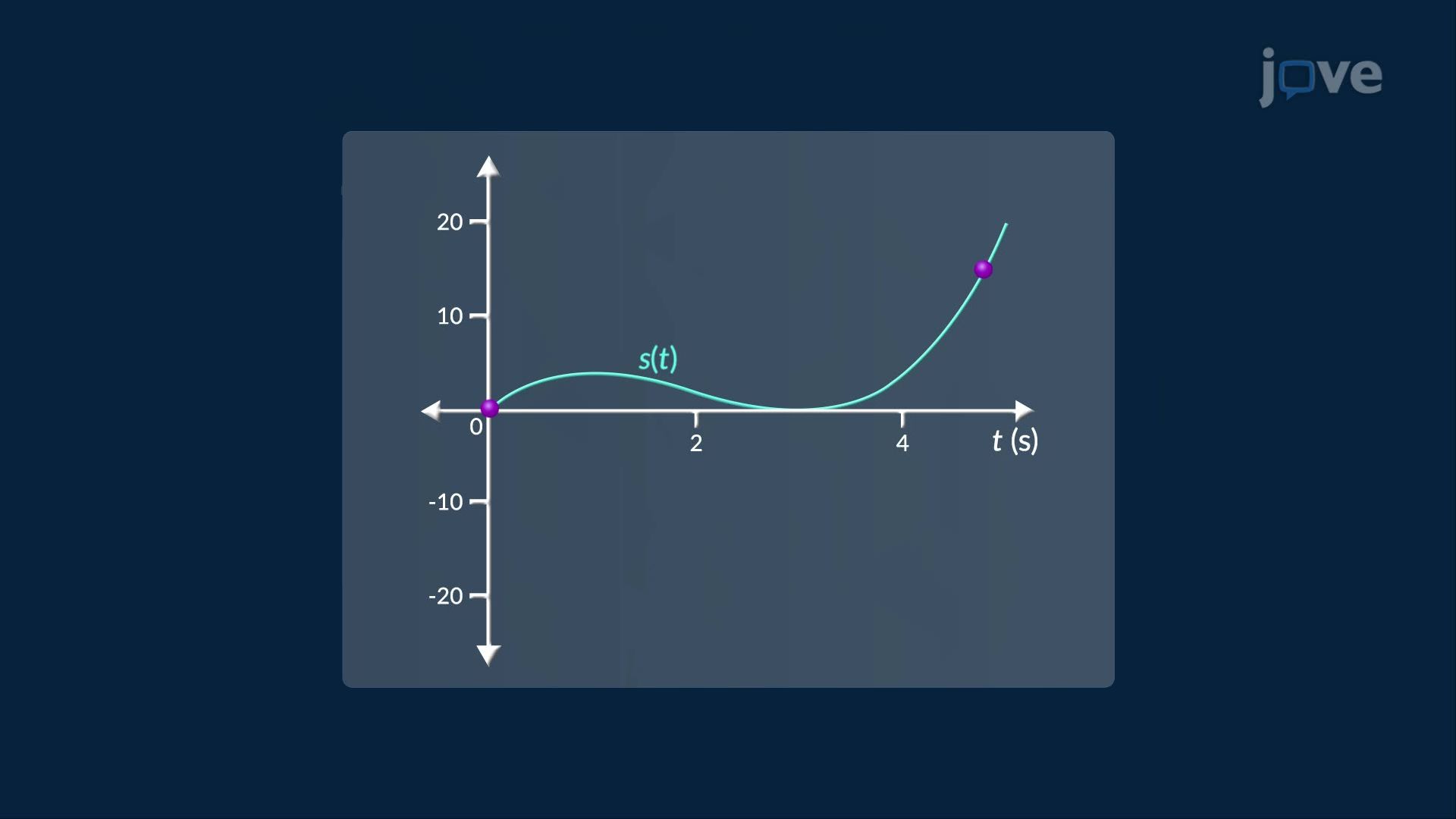
Next, integrating the velocity gives the displacement function. As the initial position is zero, the integration constant is also zero.
Since the final velocity of the car is zero, substituting this value into the velocity equation gives the stopping time.
Using this time in the displacement function and setting the displacement equal to 800 meters gives an equation for the required acceleration.
This shows how integration links acceleration, velocity, and displacement.

 繁體中文
繁體中文